
Alice in Sintra-land
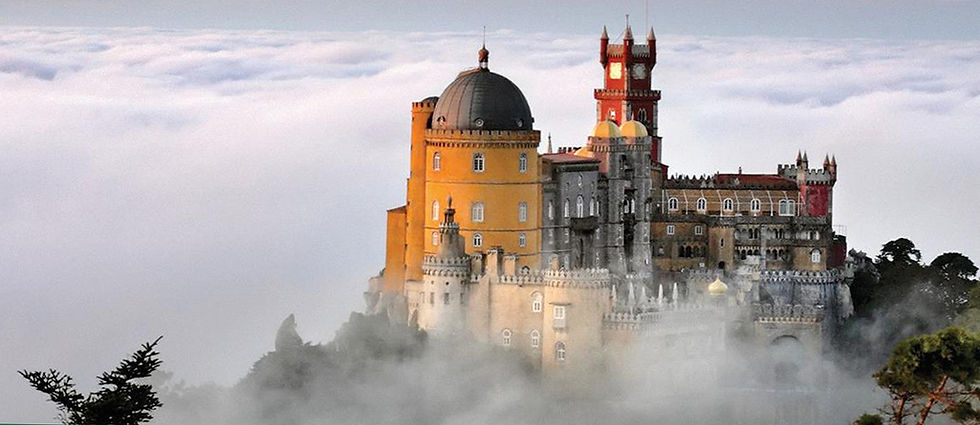

Had alice’s rabbit hole led her to sintra, chances are she would probably have felt even more bewildered than when she landed in wonderland. sintra does that to you. you see it in the faces of the people venturing out of tour buses or the unassuming train station that is, after all, the portal to a mindboggling journey to what could well be called the Portuguese wonderland.
in PTZINE | 2014
As a lisboeta, i’m proud to say i have visited sintra consistently and systematically, during all stages of my life, through really tender childhood, throughout my rebellious teens, into early adulthood, where (I like to think) I find myself now. I clearly remember what I felt when I was first there, and it’s a feeling that never left me, but has grown with me every time i happen to venture inside this rabbit hole. so, once again, here we go: Just a mere 30 minutes away from lisbon, sintra is, before being a town, the name of a seemingly enchanted mountain range that starts to faint by the time it reaches the atlantic ocean. it is that same proximity to the sea that is responsible for the region’s unique micro-climate, which is the sustenance for its mist-soaked forests. the cooler temperatures and idyllic settings have lured in romantics of all nationalities and eras – from lord Byron, who was not shy to call it “Glorious eden” and dedicate to it the most heartfelt of poems, to the romantics of our day and age, who can’t seem to get tired of the whimsical and almost supernatural character of the town that has nurtured mystics and occultists.
We start off by the historical centre of sintra, dominated by the ghostly white presence of the age-old Palácio da Vila (town Palace), with its overpowering staircases and chimneys that a visiting Hans Christian anderson once compared to giant champagne bottles. But still, from the outside, the oversized building seems to lack the grandeur and magnificence that fashion the town’s charm, but let’s not be hasty – “never judge a book by its cover”. this medieval palace was a ground-breaking first approach to the then futuristic fashion of spending the sizzling Portuguese summer amongst sintra’s fabulous palaces and shady exotic gardens. the man with the vision was King D. João I, who started this longlasting tradition in the late XIV century, building a national Palace in the town’s
sheltered cocoon. But the plainness of the outsides is compensated inside. the mixture of Moorish and Manueline styles allow us to pass through arabesque courtyards into elegant rooms, many embellished with beautiful XV and XVI century ceramic tiles (called azulejos, just so you know). above us ceilings glitter, one with exquisite paintings of gold-collared swans and another with magpies, their beaks sealed to act as a warning to gossipy ladies-in-waiting. room after room, the medieval Portuguese history seems to begin to open up to the promising adventures of the discoveries era, just a few steps down the timeline. and as time never stops, also we have to continue.
We’re right in the town’s centre. outside there is a lot to see down the old narrow streets, teeming with tourists, little shops and absolutely mouth-watering pastry shops. and, as an inveterate lover of everything sweet in life, i must warn you: you have never been to sintra until you’ve tried its signature pastries, which go perfectly with the town. roughly speaking, there are two to choose from: you can go for a small, round and deliciously fragrant Queijada (my absolute favourite), or try the filo-pastry enveloped Travesseiro, another delicacy, sweeter but somewhat ethereal in its texture. in all honesty you should try both, and pack some to take home – they’re are to die for and, to add to their charm, you can only find them here. Then, feel free to wash it all down with a small cup of Ginginha, a mild sour-cherry liqueur that is sure to sweeten your day. and the journey continues…
From the town’s centre, there’s no other place to go to but up, venturing through the winding roads lined with impossibly green vegetation. we don’t even have to go in too deep, as we’re starting to spot the twisted turrets of Quinta da regaleira, one of the most surprising and enigmatic monuments in sintra. a former summer refuge of nobles, it was purchased in 1893 by millionaire businessman Carvalho Monteiro, who, along with the italian architectstage designer luigi Marini (the architect of the scala, in Milan) designed an otherworldly occultist abode where nothing seems to have been left to chance. we close our eyes and let our soul guide us through the mysteries of regaleira, as we should – this is a proper Masonic dwelling, and i have always been told that “in rome, one must do as the romans”. the gardens are a kind of representation of the Cosmos, and i get the feeling that even the most sceptical non-believer cannot help but feel a mystical experience.
Next we have an amazing pink-coloured palace: the seteais. this grand neoclassical edifice – built in the closing decades of the XVIII century and extended by various princes in the XiX – has now been converted into a luxury hotel. Inside, the elegant rooms are decorated with magnificent frescoes and tapestries, where people like Marguerite Yourcenar, Agatha Christie, President Nixon and Johnny depp, to name only a few, have stayed.
We continue uphill, through the steep and twisting roads of sintra. roads of mystery that respectfully climb the landscape all the way to the Moorish Castle. throughout the hike we see glimpses of the ramparts looming high above. we’re embraced by ferns, lichens and moss, which seem to be permeated by light that delicately passes through to greet us. the air feels fuller, of a freshness that is bound to make you live longer. Medicinal air – they should patent that, sell it in bottles! We finally reach the castle, that to this day we call “of the Moors”, because they were the ones to build it in the Viii century. it was then conquered by the Berbers in the Xi and surrendered to the Portuguese in the Xii. standing at over 400 meters (1300 feet) above sea level and with brightly coloured flags flying from ivy-clad restored battlements and keeps, the castle is like the fantasy fortresses found in little boy’s picture books. far below we see the atlantic, deep blue and restless, while to my left and higher up still is Pena Palace, rising from a densely wooded peak like an apparition.
We continue on our way up, through oneiric roads that may well lead to the place where dear alice is still lost. through the curves and the light permeated greenery, i fear i have seen a white rabbit. i squint and it’s gone – thank god, how would you ever trust my accounts on what comes next... a bit further ahead we approach the Pena Palace, the crowning glory of sintra, and i feel as if i’m entering the realm of dreams. Pena Palace was built in the XiX century as a summer escape for Portugal’s royal family. it is sintra’s most important sight and often referred to as an “adult disneyland.” But that description seems too staid for the architectural amalgam climbing in spires and turrets above me, a mix of Moorish and Manueline styles, of pinks and peaches, crenulations and cloisters, hand-painted ceramic tiles and elaborate stone carvings.
it is akin to giving a child 10 types of ice cream, 50 toppings and the world’s largest bowl: absolute abandon. this otherworldly feeling follows us throughout my day in sintra. the wooded landscape itself seems fantastical, so verdant and fertile that settlers came here as early as the fifth millennium BC. More famous, though, is the area’s collection of palaces and gardens, which made sintra the first centre of Romantic architecture in Europe and a favourite destination of the movement’s best-known followers, including German composer Richard Strauss and the above mentioned english poet lLrd Byron.
(...)